Vivek Ramaswamy
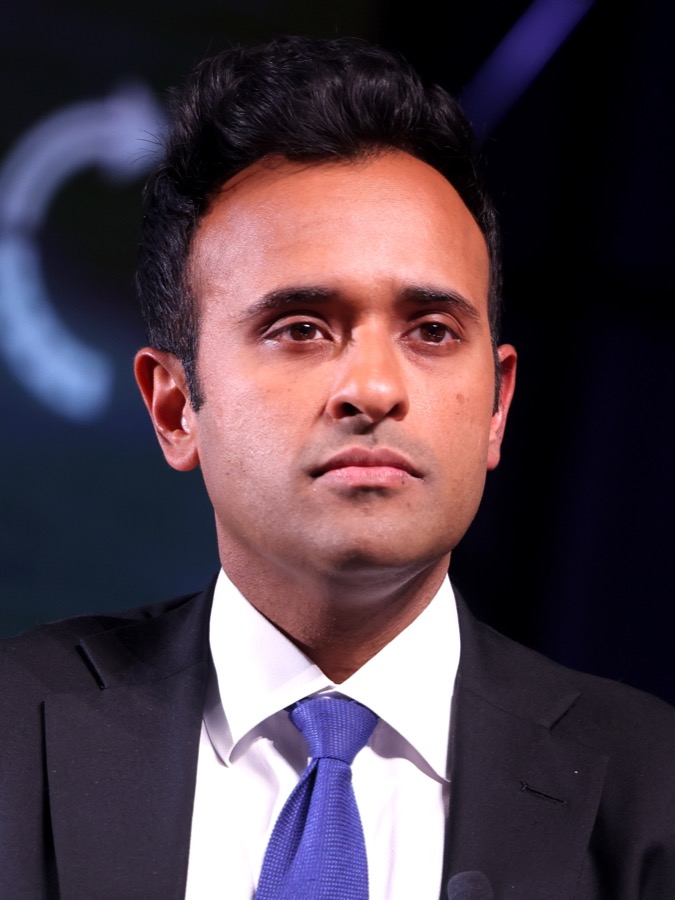
Founder of Roivant Sciences, a company that buys shelved drug candidates into separate subsidiaries; co-founder of Strive Asset Management; 2024 presidential candidate and 2026 Republican nominee for Ohio governor · b. 1985 · Cincinnati, Ohio
Two calls made by hand, not formulas. how we score →
Summary
The son of Indian immigrants, he went from Harvard to a biotech hedge fund and reportedly had about $15 million before law school ended.
In 2014 he started Roivant with roughly $100 million from QVT and other investors. Forbes puts him at $2.3 billion, mostly from Roivant.
Where they worked
How it happened
Ramaswamy was born in 1985 in Cincinnati, Ohio. His parents came from Palakkad district in Kerala, India. Wikipedia says his father was an engineer at General Electric and his mother a geriatric psychiatrist who worked for Merck and Schering-Plough. He graduated as valedictorian of St. Xavier High School in 2003. Sources consulted don't say how many siblings he has beyond that, and don't establish family income.
He earned a biology degree summa cum laude from Harvard in 2007 and co-founded a small student-networking company, Campus Venture Network, the same year; it was sold to the Kauffman Foundation in 2009. From 2007 to 2014 he worked at the hedge fund QVT Financial, where he ended up as a partner co-managing a biotech portfolio. Wikipedia reports that he claimed a net worth of about $15 million in 2013, before he finished law school.
He took a J.D. at Yale Law School, finishing in 2013, and won a Paul & Daisy Soros Fellowship for New Americans in 2011. Who paid for Harvard isn't established in the sources consulted.
In 2014 he founded Roivant Sciences in Bermuda. Per Wikipedia, it got nearly $100 million in startup capital from QVT, his employer, and investors including RA Capital and D.E. Shaw. So the founding money was other people's, not his savings. The idea was to buy drug candidates that big pharma had shelved, such as GSK's intepirdine for about $5 million, and house each in its own subsidiary. He had spent seven years at a biotech hedge fund learning which assets were underpriced, and he had the backing of the fund.
Axovant, the Alzheimer's subsidiary, went public in 2015 and raised about $315 million, reaching a valuation of nearly $3 billion with only eight employees. Wikipedia says Ramaswamy reported more than $37 million in capital gains that year. In 2017 intepirdine failed a large trial and the stock fell about 75% in a day. Forbes notes that later Roivant drug candidates did better. SoftBank put $1.1 billion into Roivant that year, and in 2019 the sale of stakes in five subsidiaries to Sumitomo Dainippon Pharma reportedly brought him $175 million in capital gains.
He stepped down as CEO in January 2021 and as chairman in February 2023. Wikipedia says he still holds about 7.17% of Roivant. Forbes says positive Phase 3 results for brepocitinib sent the stock up in late 2025. He co-founded Strive Asset Management in 2022, which Wikipedia says raised about $20 million from investors including Peter Thiel, JD Vance and Bill Ackman, and left its chairmanship to run for president. He finished fourth in the 2024 Iowa caucuses and endorsed Donald Trump. He won the May 2026 Republican primary for Ohio governor.
Forbes lists his net worth at $2.3 billion as of October 11, 2026, ranking him 1,827th and self-made. The figure is mostly his Roivant stake. Two former Strive employees have sued him and the firm. In August 2026 a federal judge let key whistleblower claims in one suit go forward. The claims are the plaintiffs' allegations, he and Strive deny them, and no finding has been made.
The coded evidence
Thirteen groups, every claim sourcedHeadwinds coded 1. He is the son of Indian immigrants, but no documented barrier to his finance or biotech career turned up. credentialFunding is coded scholarship because the Soros Fellowship funded graduate study; how Harvard was paid for is not established.
↗ en.wikipedia.orgSecond generation; born in Cincinnati to immigrant parents.
↗ en.wikipedia.orgnot established
Not established. Hardness is coded low from professional-class parents and a well-paid hedge-fund job, not from a documented fallback.
↗ en.wikipedia.orgPartner-level pay at QVT Financial, then reportedly about $15 million in net worth before Roivant was founded.
The $15 million is a figure Wikipedia attributes to Ramaswamy's own claim.
↗ en.wikipedia.orgThe hardship was imposed, not chosen. There was nothing to fall back on.
No period of chosen austerity is documented.
↗ en.wikipedia.orgFather an engineer at General Electric; mother a geriatric psychiatrist who worked for Merck and Schering-Plough.
↗ en.wikipedia.orgNeither parent was self-employed.
Both parents are described as employees of large companies.
↗ en.wikipedia.orgFather an engineer and mother a physician-psychiatrist, so both had professional training; degrees not detailed in sources consulted.
↗ en.wikipedia.orgCincinnati, Ohio
↗ en.wikipedia.orgSt. Xavier High School, a private Catholic school in Cincinnati.
↗ en.wikipedia.orgA job at QVT Financial straight out of Harvard, which later became the lead backer of Roivant.
↗ en.wikipedia.orgCapital, Credibility, Network, Skill
Coded from QVT and RA Capital funding Roivant and from his seven years analysing biotech there.
↗ en.wikipedia.orgB.A. in biology (summa cum laude), Harvard, 2007; J.D., Yale Law School, 2013.
↗ en.wikipedia.orgReportedly kept working at QVT while at Yale Law.
Wikipedia places his QVT years at 2007-2014, overlapping law school.
↗ en.wikipedia.orgPaul & Daisy Soros Fellowship for New Americans, awarded 2011.
↗ en.wikipedia.orgSalary and compensation at QVT Financial; Campus Venture Network was sold in 2009.
↗ en.wikipedia.orgnot established
Not established that his own savings funded Roivant. Wikipedia describes the startup capital as coming from QVT and outside investors.
↗ en.wikipedia.orgNearly $100 million in startup capital from QVT, RA Capital Management and D.E. Shaw; SoftBank invested $1.1 billion in 2017.
↗ en.wikipedia.orgHolding company with separate listed or private subsidiaries. Axovant went public in 2015; in 2019 Roivant sold stakes in five subsidiaries to Sumitomo Dainippon Pharma. He reportedly retains about 7.17% of Roivant.
↗ en.wikipedia.orgPer Wikipedia, he loaned his 2024 presidential campaign over $15 million in 2023.
↗ en.wikipedia.orgBuying drug candidates shelved by large pharma, starting with a GSK compound bought for about $5 million.
↗ en.wikipedia.org0
Campus Venture Network was sold, not failed. Axovant's 2017 trial failure was a drug failure, not a failed venture of his own.
↗ en.wikipedia.orgAfter the 2017 intepirdine trial failure, the Axovant stock fell about 75% in a day, so its public shareholders took that loss. How much of it fell on Ramaswamy personally is not established.
↗ en.wikipedia.orgBought rather than built. Drug candidates were acquired from large pharmaceutical companies and placed in subsidiaries.
↗ en.wikipedia.orgBiotechnology and asset management
↗ forbes.com2300000000
Forbes real-time figure as of 2026-10-11, rank 1,827, listed as self-made. Wikipedia cites Forbes at the same $2.3 billion in September 2026.
↗ forbes.comJournalistic estimate
Roivant is public, but Forbes' figure also covers other holdings. SEC proxy filings were not checked.
↗ forbes.com2026
↗ forbes.comReported realized gains include more than $37 million in 2015 and $175 million from the 2019 stake sale, per Wikipedia. Most of the $2.3 billion is paper value in a public company.
↗ en.wikipedia.orgBest-selling author of Woke, Inc. (2021); finished fourth in the 2024 Iowa Republican caucuses; won the May 2026 Republican primary for Ohio governor with 82.5% of the vote.
↗ en.wikipedia.orgUncapped
↗ forbes.comTwo former Strive employees have sued Ramaswamy and Strive. One, a former executive, alleges she was pressured to violate securities laws and was fired after objecting; the other alleges he was given an overly optimistic picture of Strive's finances when he left a job to join. In August 2026 a federal judge declined to dismiss key whistleblower claims in the first suit, which means the complaint's allegations were enough to proceed, not that they were found true. Ramaswamy and Strive have denied the allegations and say the executive was an underperformer let go in a reorganization. No finding has been made.
The August ruling and the denial come from a search-result summary of press coverage; the court record itself was not consulted.
↗ endpts.comStructural context
The cost-of-failure score comes from this person's own money and circumstances. But who they were in America carried its own weight, the same way their household or income did, and it shaped how hard the path was just as much. That part isn't in the cost-of-failure number. It's here instead.
Men founded the companies that took nearly all the venture funding and almost every top outcome, a tailwind that never shows up in one person's own circumstances.
↗ techcrunch.comImmigrants and their children are overrepresented among America's biggest companies, as founders and as senior leaders. They got there through the visa, credential, and network hurdles that make the path harder to even start down.
↗ forbes.comAmong the people recorded here — men: 225. Representation here is who reached these outcomes, not equal odds of reaching them.
Controlled comparisons
Each holds one thing constant and varies another, so the difference is the point. A list of similar names wouldn't tell you anything.