Daniel Lubetzky
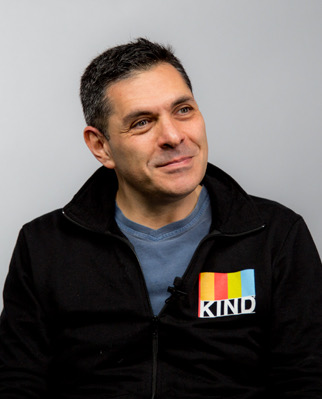
Founder of KIND snacks, which Mars bought out for a reported $5 billion in 2020, and of PeaceWorks and the Starts With Us movement · b. 1968 · Mexico City, Mexico → San Antonio, Texas → New York City
Two calls made by hand, not formulas. how we score →
Summary
The son of a Holocaust survivor who built a successful retail business in Mexico, he went from Trinity University to Stanford Law, then spent years selling Middle East peace-through-trade foods from his own savings with no salary.
KIND grew out of that company, took a minority investment in 2008, and sold to Mars in stages ending in 2020.
People in this set who share a company with Daniel Lubetzky.
Where they worked
How it happened
Lubetzky was born in Mexico City in 1968. His father, Roman, survived the Dachau concentration camp, emigrated to Mexico after the war and, according to Stanford Lawyer, worked in a jewelry shop before opening his own and becoming a successful businessman despite a third-grade education. Wikipedia describes him as a partner in duty-free shop chains based in Laredo, Texas. Lubetzky has credited his parents with teaching him integrity and perseverance.
The family moved to San Antonio when he was a teenager, per Hispanic Executive. In high school and college he bought watches wholesale and resold them at flea markets, a trade he'd picked up from his father's world. He studied economics and international relations at Trinity University, with time abroad in Israel and France.
He earned a JD from Stanford Law School in 1993 and briefly worked at Sullivan & Cromwell and at McKinsey. Both gave him a professional credential and a place to return to.
In 1993 he won a Haas Koshland Fellowship to research joint business ventures between Arabs and Israelis. While doing it he came across a sun-dried tomato spread business in Israel that had gone under. He put in his own savings, relaunched it as PeaceWorks in 1994, and filled his briefcase with jars to sell door to door.
Hispanic Executive reports he went without pay for several years while inventory piled up in his small apartment. PeaceWorks built a supplier network and, in his telling, the business connections that later helped launch KIND. In 2002 he also co-founded the OneVoice Movement.
He started KIND in 2004 after seeing a bar of whole nuts and fruit during PeaceWorks travel, and Wikipedia puts first-year revenue near $1 million. VMG Partners invested in 2008 to pay for a big expansion of free sampling. Mars took a minority stake in 2017 at a reported valuation above $4 billion and announced the full acquisition for $5 billion in November 2020.
Per Wikipedia he sold his remaining stake in 2025 and is no longer involved in operations. He now runs the family office Camino Partners, sits as a guest and later main shark on Shark Tank, and launched the Starts With Us movement in 2021. Forbes put his net worth at $2.3 billion in October 2026.
The coded evidence
Thirteen groups, every claim sourcedCoded from public photographs and family-origin descriptions, not a self-declaration.
↗ en.wikipedia.orgLithuanian-Mexican; Ashkenazi Jewish
coded.ethnicities uses the existing "Mexican" and "Ashkenazi Jewish" buckets. The Wikipedia article describes the Lubetzky family origin as Lithuanian Ashkenazi Jewish.
↗ en.wikipedia.orgBorn in Mexico to a Holocaust-survivor father who had emigrated to Mexico after the war; moved with his family to San Antonio as a teenager.
Exact age at the move is not given in the sources consulted.
↗ hispanicexecutive.comnot established
Whether his parents' home or money was available as a fallback is not stated.
↗ hispanicexecutive.comTook no salary for several years while building PeaceWorks, living on what he had saved and with inventory stored in his apartment.
How he covered living costs in those years is not described beyond his own savings.
↗ hispanicexecutive.comnot established
He married in 2008, after both PeaceWorks and the KIND launch; no source describes partner support during the build.
↗ en.wikipedia.orgThe hardship was chosen. There was a home to go back to if it failed.
He left a law and consulting track by choice and could have returned to it.
↗ hispanicexecutive.comFather Roman Lubetzky, a Holocaust survivor who became a successful retail businessman in jewelry and duty-free shops; mother Sonia, occupation not established.
↗ en.wikipedia.orgA parent worked for themselves, the strongest known predictor of founding.
Stanford Lawyer says his father opened his own jewelry shop; Wikipedia calls him a partner in duty-free chains.
↗ law.stanford.eduFather had a third-grade education, per Stanford Lawyer; mother's schooling not established.
↗ law.stanford.eduFather is a Lithuanian-born Holocaust survivor who emigrated to Mexico after 1945. Lubetzky has said the stories shaped his book Do the Kind Thing.
↗ en.wikipedia.orgnot established
Stanford Lawyer gives no information on how his degrees were paid for.
↗ law.stanford.eduMexico City, then San Antonio, Texas; no ZIP-level mobility join performed.
↗ hispanicexecutive.comMexico City to San Antonio with his family in his teens; Trinity University (San Antonio), study abroad in Israel and France, Stanford Law, then New York.
↗ hispanicexecutive.comThe Haas Koshland Fellowship in 1993, which sent him to the Middle East and led him to the tomato business that became PeaceWorks.
↗ en.wikipedia.orgPeaceWorks, whose supplier relationships and business contacts he says helped him launch KIND.
↗ law.stanford.edu1
A short stint in law and consulting before the fellowship, though he had run small resale trades since high school.
↗ en.wikipedia.orgSold PeaceWorks jars door to door out of a briefcase, per Stanford Lawyer.
↗ law.stanford.eduJD, Stanford Law School (1993); BA in economics and international relations, Trinity University, magna cum laude
↗ en.wikipedia.orgnot established
How the degrees were paid for is not established, so coded.credentialFunding of self-funded is a placeholder at low confidence.
↗ law.stanford.eduPrivate university, elite law school, then a law firm and McKinsey before the fellowship.
↗ en.wikipedia.orgHis own savings, invested in relaunching the bankrupt tomato-spread business as PeaceWorks in 1994.
The amount is not stated in any source consulted.
↗ law.stanford.edunot established
No source says whether his parents lent or gave money to PeaceWorks or KIND. His father's business success makes this a real open question.
↗ law.stanford.edunot established
Hispanic Executive says the business was financially hard and he went unpaid for years; whether sales covered costs is not stated.
↗ hispanicexecutive.comSavings put into PeaceWorks; whether they came from his short law and consulting pay or from earlier family or resale money is not stated.
↗ law.stanford.eduKIND was started in 2004 and had about $1 million in first-year revenue. VMG Partners invested in 2008. Initial start-up capital for KIND is not disclosed in any source consulted.
↗ en.wikipedia.orgMars bought a minority stake in 2017 and announced full acquisition of Kind North America in November 2020 for a reported $5 billion. Wikipedia reports he sold his remaining stake in 2025.
Forbes describes a controlling Mars stake and an undisclosed remaining stake for Lubetzky; the two sources differ on the endpoint.
↗ en.wikipedia.orgSaw a bar of whole nuts and fruit in Australia while traveling for PeaceWorks, per Forbes, and wanted a healthy, convenient snack.
↗ forbes.comnot established
Share classes and voting control before the sale are not established in the sources consulted.
↗ forbes.com0
PeaceWorks was a struggle but not a documented failure, and the tomato company he relaunched had gone bankrupt before he took it over.
↗ law.stanford.eduHimself, through unpaid years and his own savings; no outright failure occurred.
↗ hispanicexecutive.comNew York City
The company is described as based in New York City today; the 2004 location is not confirmed.
↗ en.wikipedia.org16
2004 to the 2020 Mars buyout; he stayed involved until selling the rest in 2025.
↗ en.wikipedia.orgSnack foods and consumer brands, plus investing and social ventures
↗ forbes.com2300000000
Forbes real-time figure on the retrieval date. Wikipedia cites $2.2 billion in November 2021. Peak was not separately established.
↗ forbes.comJournalistic estimate
↗ forbes.com2026
↗ forbes.comMars paid in cash for the 2020 acquisition, per reporting on the $5 billion deal, and he is reported to have sold his remaining stake in 2025, so most of the wealth is likely realized.
The cash terms and his proceeds were not confirmed from a primary source.
↗ en.wikipedia.orgAuthor of the bestseller Do the Kind Thing, Presidential Ambassador for Global Entrepreneurship (2015), Skoll Award winner (2008, with a $1,000,000 grant to the PeaceWorks Foundation), and a main shark on Shark Tank since 2024.
↗ en.wikipedia.orgUncapped
↗ en.wikipedia.orgIn 2015 the FDA challenged Kind's use of "healthy" on four snack bars, saying the products exceeded the saturated-fat limit for the claim. Per Wikipedia, Kind revised the labels and reviewed its full product line. A company representative told NPR the nuts in its recipes account for the fat levels.
↗ en.wikipedia.orgAfter
↗ en.wikipedia.orgIncidental
↗ en.wikipedia.orgLegal gray
↗ en.wikipedia.orgNone
Labels were revised; no fine or personal liability is documented in the sources consulted.
↗ en.wikipedia.orgMission driven, Kindness focused, cause-minded entrepreneur
↗ hispanicexecutive.comPublic
↗ en.wikipedia.orgAfter
↗ en.wikipedia.orgThe reputation was deliberately built, through books, press, and PR.
↗ en.wikipedia.orgStructural context
The cost-of-failure score comes from this person's own money and circumstances. But who they were in America carried its own weight, the same way their household or income did, and it shaped how hard the path was just as much. That part isn't in the cost-of-failure number. It's here instead.
Men founded the companies that took nearly all the venture funding and almost every top outcome, a tailwind that never shows up in one person's own circumstances.
↗ techcrunch.comImmigrants and their children are overrepresented among America's biggest companies, as founders and as senior leaders. They got there through the visa, credential, and network hurdles that make the path harder to even start down.
↗ forbes.comAmong the people recorded here — men: 225 · white subjects: 24. Representation here is who reached these outcomes, not equal odds of reaching them.
Controlled comparisons
Each holds one thing constant and varies another, so the difference is the point. A list of similar names wouldn't tell you anything.
Related companies
Companies connected to Daniel Lubetzky through the profiled people they worked with. Each card says who the link runs through.