Daymond John
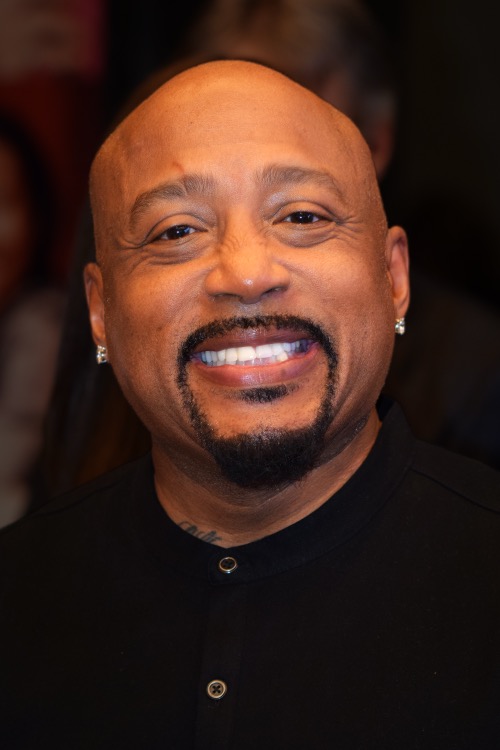
Founder, FUBU; Shark Tank investor · b. 1969 · Brooklyn, New York → Hollis, Queens
Two calls made by hand, not formulas. how we score →
Summary
He sewed wool hats with a neighbor in his mother's Hollis, Queens house and waited tables at Red Lobster to cover the gap.
A 1994 trade show brought $300,000 of orders he couldn't fill, and twenty-seven banks turned him down, so his mother mortgaged their home for $100,000. It was nearly gone within months before a newspaper ad found the partner that let FUBU ship what it had already sold.
How it happened
Daymond John was born in Brooklyn in 1969 and grew up an only child in Hollis, Queens, the son of Caribbean immigrants: his father from Trinidad, his mother from Barbados. His parents divorced when he was about ten, and his mother, a flight attendant who often worked more than one job, raised him from there. He struggled with reading and spelling all through school, pulling C's and D's in language arts against A's and B's in math and science, and wasn't diagnosed with dyslexia until his thirties. At Bayside High School he chose the co-op track, alternating a full week of classes with a full week of paid work at a Manhattan investment bank, which cut his coursework in half and put him in the working world early.
In 1992 he sewed wool ski hats with a next-door neighbor in his mother's house and sold them for $10 on a Jamaica Avenue corner, clearing $800 in a single day. He recruited childhood friends into the venture and kept the Red Lobster job through the early years, funding the brand between shifts. A neighborhood connection paid off when LL Cool J agreed to wear FUBU gear in a Gap commercial, and by 1994 a Las Vegas trade show had produced roughly $300,000 in retailer orders.
He had the orders and no way to fill them. Twenty-seven banks turned him down for a loan. His mother mortgaged the family home, worth an estimated $75,000, for $100,000 to fund production. Within three months the money had been mismanaged down to about $500 and the mortgage payments were falling behind. Her next move was a newspaper ad looking for a manufacturing partner, which surfaced the deal with Samsung's textile division that let FUBU fill the orders it had already sold.
FUBU stood for "For Us, By Us," sold explicitly out of hip-hop culture rather than licensed from it, at a moment when the fashion establishment mostly treated that audience as a market rather than a customer. The Samsung deal scaled production, sales peaked at more than $350 million in a single year in 1998, and the brand went on to report over $6 billion in cumulative global sales.
He joined Shark Tank in 2009 and has since invested more than $8.5 million across its companies, run the Shark Group brand-consulting firm, and published five books, including the NAACP Image Award-winning "The Power of Broke." Estimates put his personal net worth near $350 million, a full order of magnitude below FUBU's lifetime company sales, which is a different number measuring a different thing.
The coded evidence
Thirteen groups, every claim sourcedAfrican American with Caribbean immigrant parentage: father from Trinidad, mother from Barbados.
Consistent across several secondary biography sites but not confirmed in top-tier journalism or a first-person account; treat with caution.
↗ wealthypeeps.comSecond-generation (both parents Caribbean-born immigrants).
Same sourcing caveat as ethnicity above.
↗ thecityceleb.comHis mother's house in Hollis, Queens, which doubled as FUBU's factory and warehouse. Housing itself was never at risk of loss to him personally; the mortgage risk sat on his mother's asset.
↗ en.wikipedia.orgKept working as a waiter at Red Lobster through FUBU's early years, funding the business between shifts rather than living off it.
↗ en.wikipedia.orgNot his own debt directly, but his mother carried a $100,000 mortgage against a house reportedly worth about $75,000, and fell behind on payments after the loan was drawn down to roughly $500 within months.
The precipitating CNBC interview is described secondhand here; treated as medium rather than high confidence.
↗ afrotech.comThe family home came close to foreclosure risk after the mortgaged capital was burned through faster than expected, though John himself retained housing and a paying job throughout.
↗ afrotech.comThe hardship was imposed, not chosen. There was nothing to fall back on.
The Red Lobster job and street-corner hat sales were necessity, not a chosen minimalism; there was no standing wealth to fall back on if he simply stopped.
↗ en.wikipedia.orgFather Garfield John, from Trinidad; mother Margot John, from Barbados, worked as a flight attendant and often held more than one job at a time.
Secondary biography aggregators only; not corroborated in major press.
↗ wealthypeeps.comnot established
No documented moves or housing instability beyond the parents' divorce; not established either way.
↗ en.wikipedia.orgDyslexic; not diagnosed until around age 30, having been misread as a behavioral problem in childhood. Struggled with reading and spelling through school (C's and D's in language arts against A's and B's in math and science) and managed it by choosing a work-study high school track and, later, delegating document review to colleagues.
↗ dyslexia.yale.eduHollis, Queens, a working- to middle-class Black and Caribbean-immigrant neighborhood, in the 1970s and 1980s.
↗ en.wikipedia.orgFUBU ("For Us, By Us") was built and marketed as apparel made from inside hip-hop culture rather than licensed to it from outside, at a time when mainstream fashion brands courted that audience as customers without crediting it as a source. The name itself is also reported more simply as a catchy four-letter word in the mold of Nike or Coke; both framings appear in the record.
↗ en.wikipedia.orgLL Cool J, a neighborhood connection, agreed to wear FUBU gear in a Gap commercial in the mid-1990s, giving the brand its first wide visibility.
↗ en.wikipedia.orgCold. Sold hand-sewn hats himself on a Jamaica Avenue street corner; the Montego Bay clothing store on the same avenue became the first retail account.
↗ en.wikipedia.orgNo agent, no introduction to the fashion industry. Sold on the street, recruited friends as co-founders, and financed the first orders himself before any institutional relationship existed.
↗ en.wikipedia.orgFounded FUBU with three friends: Carlton E. Brown, J. Alexander Martin, and Keith C. Perrin, met through the neighborhood rather than through school or industry.
↗ en.wikipedia.orgNo college. Graduated Bayside High School (Queens) through a co-op program that alternated a full week of classes with a full week of paid work at a Manhattan investment bank.
↗ dyslexia.yale.eduDirect to the workforce. The high school co-op track itself functioned as an early apprenticeship, placing him inside a Wall Street office as a teenager rather than routing him toward a degree.
↗ dyslexia.yale.eduProceeds from selling roughly 90 hand-sewn wool hats at $10 each on a Queens street corner in 1992, plus continued Red Lobster wages.
↗ en.wikipedia.orgHis mother took out a $100,000 mortgage on the family home, reportedly worth around $75,000, to fund production once orders outpaced what street sales and wages could finance.
↗ afrotech.comIt paid its own way from the start. Revenue came before any outside money.
Selling hats and shirts funded operations before any outside capital arrived.
↗ en.wikipedia.orgSamsung's textile division responded to a newspaper ad his mother placed and became a manufacturing and financing partner, supplying production capacity rather than a passive check.
↗ en.wikipedia.orgPersonal experience inside hip-hop culture and street fashion in Queens, built and sold as apparel from within that community.
↗ en.wikipedia.orgThe $100,000 was not family savings sitting idle; it was home equity drawn against a house worth less than the loan, converting the family's one hard asset into working capital and putting it at real risk of foreclosure when the money was mismanaged down to about $500 within a few months.
↗ afrotech.comTwenty-seven banks declined to lend before his mother's mortgage became the funding source. He has attributed the rejections to not yet knowing how to properly fill out loan paperwork, not to discrimination.
↗ afrotech.comSelf, from Red Lobster wages and street sales, and his mother, whose mortgaged home absorbed the largest single risk.
↗ afrotech.comThe mid-1990s emergence of hip-hop-affiliated streetwear as a mainstream retail category, which national department stores and apparel licensors had not yet fully entered.
↗ en.wikipedia.orgBuilt from nothing: a brand, a factory improvised inside a house, and a customer base assembled street corner by street corner.
↗ en.wikipedia.orgFashion and apparel; later media and brand consulting via Shark Tank
↗ en.wikipedia.orgAggregator
↗ celebritynetworth.comOwnership stakes across FUBU, Shark Group, and Shark Tank portfolio companies (notably a reported minority stake in Bombas), plus television and speaking income. FUBU's often-cited $6 billion in lifetime sales is company revenue, not personal wealth.
↗ celebritynetworth.comNAACP Image Award for "The Power of Broke" (2016); twice named NAACP Entrepreneur of the Year; Ernst & Young New York Entrepreneur of the Year; appointed a Presidential Ambassador for Global Entrepreneurship in 2015.
↗ en.wikipedia.orgUncapped
↗ en.wikipedia.orgIn 2023 John sought and initially obtained a temporary restraining order against Shark Tank investees Al "Bubba" Baker and family (Bubba's-Q) over social media posts he called disparaging; the family countered that he had misrepresented deal terms and excluded them from decisions. A New Jersey federal judge granted the restraining order in July 2023; a separate filing was later dismissed without prejudice on jurisdictional grounds and an amended complaint followed. No finding of wrongdoing against John was established in the sources reviewed.
Press accounts of the procedural history vary in detail; the broad shape (restraining order sought and granted, underlying business dispute contested by both sides) is consistent across them.
↗ foxbusiness.comAfter
↗ foxbusiness.comUnrelated
A dispute with a later Shark Tank investment, decades after FUBU's rise; it played no role in producing his original outcome.
↗ foxbusiness.comCivil wrong
↗ foxbusiness.comNone
No personal liability or adverse judgment against John established in the sources reviewed.
↗ foxbusiness.comResourceful, Self made, Resilient, open about his dyslexia
↗ dyslexia.yale.eduPublic
↗ en.wikipedia.orgAsset
The "broke to billions" narrative is central to his books, speaking career, and Shark Tank persona rather than a liability he manages.
↗ en.wikipedia.orgStructural context
The cost-of-failure score comes from this person's own money and circumstances. But who they were in America carried its own weight, the same way their household or income did, and it shaped how hard the path was just as much. That part isn't in the cost-of-failure number. It's here instead.
Men founded the companies that took nearly all the venture funding and almost every top outcome, a tailwind that never shows up in one person's own circumstances.
↗ techcrunch.comBlack-founded startups got roughly 0.5% of US venture funding in 2023, while Black Americans are about 14% of the population. That gap holds no matter where a founder personally started.
↗ techcrunch.comImmigrants and their children are overrepresented among America's biggest companies, as founders and as senior leaders. They got there through the visa, credential, and network hurdles that make the path harder to even start down.
↗ forbes.comAmong the people recorded here — men: 169 · Black subjects: 58. Representation here is who reached these outcomes, not equal odds of reaching them.
Controlled comparisons
Each holds one thing constant and varies another, so the difference is the point. A list of similar names wouldn't tell you anything.